WHERE DO YOU STAND?
Every organisation starts from a different place
Click on the scenario that best reflects your organisation and reporting objectives. This includes companies preparing their first full ESRS report – whether mandatory or voluntary – organisations that paused implementation following recent regulatory developments, those looking to refine or streamline existing sustainability reporting, as well as organisations exploring proportionate voluntary reporting under frameworks such as the VS (formerly VSME) or ISSB.
Preparing for first-time reporting
First full ESRS report as company within the mandatory scope, or
Restarting first full ESRS report after regulatory changes, or
Preparing a first full ESRS report on a voluntary basis.
Enhancing existing reporting
Refining existing ESRS reporting and adapting to revised requirements.
Looking for a voluntary, but less complex sustainability reporting?
Explore VS & ISSB →
WHAT IS CSRD & SUSTAINABILITY REPORTING?
Turning sustainability into structured reporting
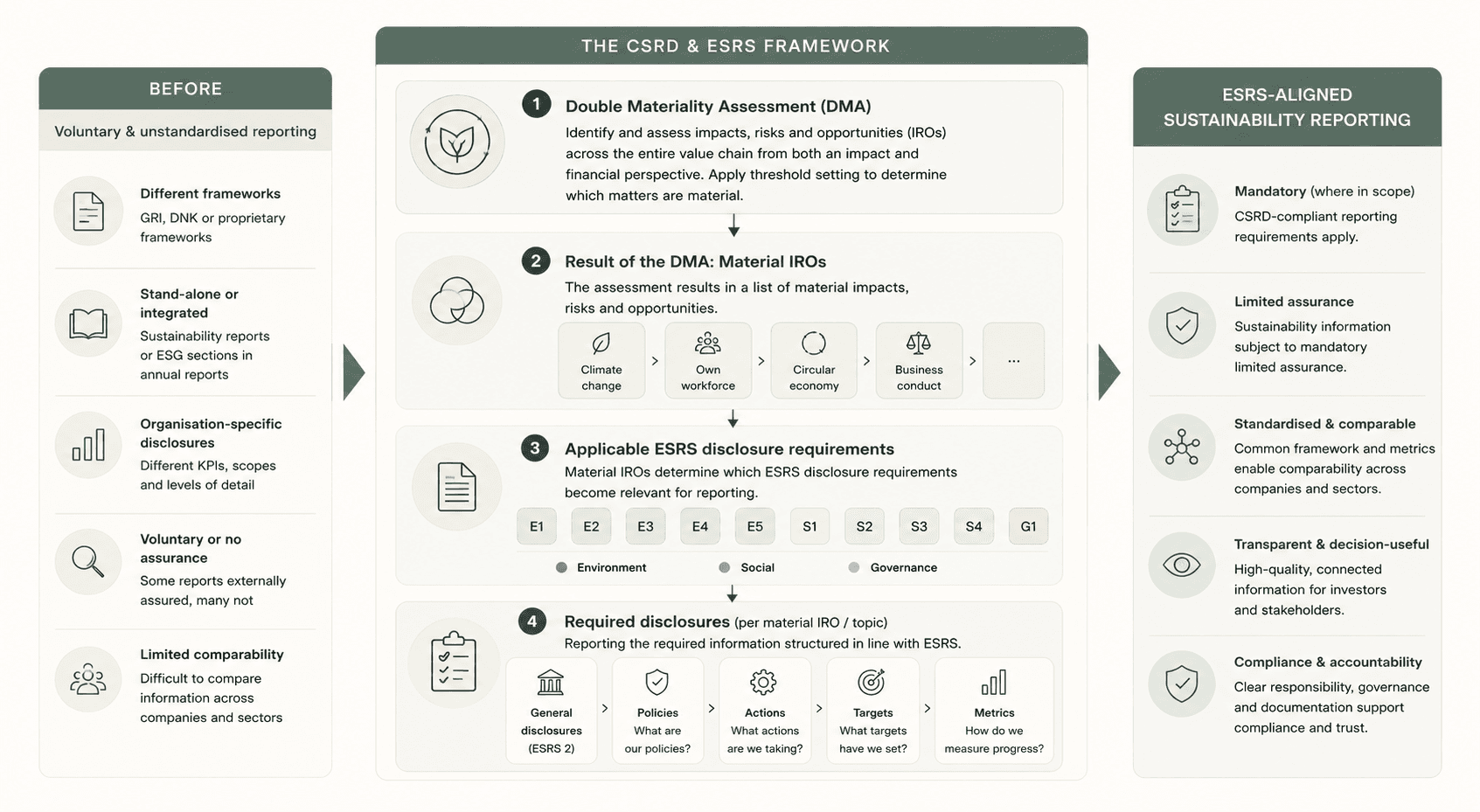
The Corporate Sustainability Reporting Directive (CSRD) and the European Sustainability Reporting Standards (ESRS) establish a structured framework for sustainability reporting. Through a Double Materiality Assessment, organisations identify their material impacts, risks and opportunities and determine the relevant ESRS disclosure requirements. The resulting reporting combines general disclosures with policies, actions, targets and metrics to provide transparent, comparable and decision-useful sustainability information.
KEY IMPLICATIONS
What CSRD reporting means in practice
Cross-functional collaboration
Reporting under assurance
Management ownership and governance
Building sustainable reporting processes
Sustainability reporting rarely sits within a single function. Finance, Sustainability, HR, Procurement, Operations and Legal often need to work together to provide information, establish responsibilities and coordinate reporting across the organisation.
For many sustainability teams, CSRD marks the transition from communication-focused reporting to compliance-driven reporting subject to external assurance. Tight deadlines and close collaboration with auditors introduce an entirely new way of working.
CSRD implementation requires active management involvement and clear governance. Treating sustainability reporting as a company-wide reporting process is key to long-term success.
Many organisations need to establish new data flows and reporting processes across functions and entities. At the same time, existing reports and disclosures can often be leveraged rather than recreated from scratch.
TIMELINE
From preparation to first reporting
Q3 2026
Final ESRS
European Commission adopted the final delegated act containing the simplified European Sustainability Reporting Standards, providing the basis for first-time implementation planning.
Q3–Q4 2026
Build the foundation
Confirm applicability, determine reporting scope, review existing reporting and establish governance for implementation.
BARNS Step 1
Q4 2026–Q1 2027
Assess what matters
Perform the Double Materiality Assessment, identify material IROs and determine applicable ESRS disclosure requirements.
BARNS Step 2
FY 2027
Design, implement and test
Embed the neu reporting framework, establish reporting processes and validate disclosures through dry runs.
BARNS Steps 3-6
FY 2027 Reporting
First mandatory application
Publish the first IFRS 18 financial statements, including comparative information under the new requirements.
BARNS Step 7
Approximate timelines. Actual project duration depends on data availability, stakeholder responsiveness, organisational capacity and implementation scope.
THE BARNS APPROACH
Starting with clarity
Every situation is different — but most projects follow a recognisable arc. The depth and focus of each phase depends on the specific standard, organisation and starting point. The timeline above illustrates how these phases typically unfold over the course of a first-time implementation project.
1
Requirements & intial impact assessment
2
Detailed technical assessment & addressing gaps
3
Reporting framework design
4
Implementation & coordination
5
Training & knowledge transfer
6
Dry run & validation
7
First time reporting & audit readiness
Looking closer at the first step


Based on the Step 1 readiness assessment, you can decide whether to continue internally or move into Step 2 – Detailed Technical Assessment together with BARNS. As Step 2 includes the Double Materiality Assessment, the applicable ESRS disclosure requirements and resulting data points are only determined at that stage, allowing for a focused and efficient assessment.
The auditor's perspective – built in from the start:
Led by a licensed Wirtschaftsprüfer (German Public Auditor / CPA equivalent), BARNS understands not only how new reporting requirements are implemented, but also how they may later be challenged in an assurance context.

AREA OF FOCUS
AREA OF FOCUS
CSRD Reporting.
CSRD Reporting.
CSRD Reporting.
New expectations. A practical way forward.
New expectations.
A practical way forward.
New expectations. A practical way forward.
Sustainability reporting has changed significantly in recent years. As CSRD requirements, ESRS and scope considerations continue to evolve, many organisations are reassessing their reporting approach. Others report voluntarily to meet stakeholder expectations or advance their sustainability ambitions. BARNS helps you focus on what matters.
Sustainability reporting has
changed significantly in recent
years. As CSRD requirements, ESRS and
scope considerations continue to evolve,
many organisations are reassessing their reporting
approach. Others report voluntarily to meet stakeholder expectations or advance their sustainability ambitions. BARNS helps you focus on what matters.
Sustainability reporting has changed significantly in recent years. As CSRD requirements, ESRS and scope considerations continue to evolve, many organisations are reassessing their reporting approach. Others report voluntarily to meet stakeholder expectations or advance their sustainability ambitions. BARNS helps you focus on what matters.
WHERE DO YOU STAND?
Every organisation starts from a different place
Click on the scenario that best reflects your organisation and reporting objectives. This includes companies preparing their first full ESRS report – whether mandatory or voluntary – organisations that paused implementation following recent regulatory developments, those looking to refine or streamline existing sustainability reporting, as well as organisations exploring proportionate voluntary reporting under frameworks such as the VS (formerly VSME) or ISSB.
Preparing for first-time reporting
First full ESRS report as company within the mandatory scope, or
Restarting first full ESRS report after regulatory changes, or
Preparing a first full ESRS report on a voluntary basis.
Enhancing existing reporting
Refining existing ESRS reporting and adapting to revised requirements.
Looking for a voluntary, but less complex sustainability reporting?
Explore VS & ISSB →
WHAT IS CSRD & SUSTAINABILITY REPORTING?
Turning sustainability into structured reporting
The Corporate Sustainability Reporting Directive (CSRD) and the European Sustainability Reporting Standards (ESRS) establish a structured framework for sustainability reporting. Through a Double Materiality Assessment, organisations identify their material impacts, risks and opportunities and determine the relevant ESRS disclosure requirements. The resulting reporting combines general disclosures with policies, actions, targets and metrics to provide transparent, comparable and decision-useful sustainability information.
KEY IMPLICATIONS
What CSRD reporting means in practice
Cross-functional collaboration
Reporting under assurance
Management ownership and governance
Building sustainable reporting processes
Sustainability reporting rarely sits within a single function. Finance, Sustainability, HR, Procurement, Operations and Legal often need to work together to provide information, establish responsibilities and coordinate reporting across the organisation.
For many sustainability teams, CSRD marks the transition from communication-focused reporting to compliance-driven reporting subject to external assurance. Tight deadlines and close collaboration with auditors introduce an entirely new way of working.
CSRD implementation requires active management involvement and clear governance. Treating sustainability reporting as a company-wide reporting process is key to long-term success.
Many organisations need to establish new data flows and reporting processes across functions and entities. At the same time, existing reports and disclosures can often be leveraged rather than recreated from scratch.
TIMELINE
From preparation to first reporting
Q3 2026
Final ESRS
European Commission adopted the final delegated act containing the simplified European Sustainability Reporting Standards, providing the basis for first-time implementation planning.
Q3–Q4 2026
Build the foundation
Confirm applicability, determine reporting scope, review existing reporting and establish governance for implementation.
BARNS Step 1
Q4 2026–Q1 2027
Assess what matters
Perform the Double Materiality Assessment, identify material IROs and determine applicable ESRS disclosure requirements.
BARNS Step 2
FY 2027
Design, implement and test
Embed the neu reporting framework, establish reporting processes and validate disclosures through dry runs.
BARNS Steps 3-6
FY 2027 Reporting
First mandatory application
Publish the first IFRS 18 financial statements, including comparative information under the new requirements.
BARNS Step 7
Approximate timelines. Actual project duration depends on data availability, stakeholder responsiveness, organisational capacity and implementation scope.
THE BARNS APPROACH
Starting with clarity
Every situation is different — but most projects follow a recognisable arc. The depth and focus of each phase depends on the specific standard, organisation and starting point. The timeline above illustrates how these phases typically unfold over the course of a first-time implementation project.
1
Requirements & intial impact assessment
2
Detailed technical assessment & addressing gaps
3
Reporting framework design
4
Implementation & coordination
5
Training & knowledge transfer
6
Dry run & validation
7
First time reporting & audit readiness
Looking closer at the first step
Based on the Step 1 readiness assessment, you can decide whether to continue internally or move into Step 2 – Detailed Technical Assessment together with BARNS. As Step 2 includes the Double Materiality Assessment, the applicable ESRS disclosure requirements and resulting data points are only determined at that stage, allowing for a focused and efficient assessment.
The auditor's perspective – built in from the start:
Led by a licensed Wirtschaftsprüfer (German Public Auditor / CPA equivalent), BARNS understands not only how new reporting requirements are implemented, but also how they may later be challenged in an assurance context.
WHERE DO YOU STAND?
Every organisation starts from a different place
Click on the scenario that best reflects your organisation and reporting objectives. This includes companies preparing their first full ESRS report – whether mandatory or voluntary – organisations that paused implementation following recent regulatory developments, those looking to refine or streamline existing sustainability reporting, as well as organisations exploring proportionate voluntary reporting under frameworks such as the VS (formerly VSME) or ISSB.
Preparing for first-time reporting
First full ESRS report as company within the mandatory scope, or
Restarting first full ESRS report after regulatory changes, or
Preparing a first full ESRS report on a voluntary basis.
Enhancing existing reporting
Refining existing ESRS reporting and adapting to revised requirements.
Looking for a voluntary, but less complex sustainability reporting?
Explore VS & ISSB →
WHAT IS CSRD & SUSTAINABILITY REPORTING?
Turning sustainability into structured reporting
The Corporate Sustainability Reporting Directive (CSRD) and the European Sustainability Reporting Standards (ESRS) establish a structured framework for sustainability reporting. Through a Double Materiality Assessment, organisations identify their material impacts, risks and opportunities and determine the relevant ESRS disclosure requirements. The resulting reporting combines general disclosures with policies, actions, targets and metrics to provide transparent, comparable and decision-useful sustainability information.
KEY IMPLICATIONS
What CSRD reporting means in practice
Cross-functional collaboration
Reporting under assurance
Management ownership and governance
Building sustainable reporting processes
Sustainability reporting rarely sits within a single function. Finance, Sustainability, HR, Procurement, Operations and Legal often need to work together to provide information, establish responsibilities and coordinate reporting across the organisation.
For many sustainability teams, CSRD marks the transition from communication-focused reporting to compliance-driven reporting subject to external assurance. Tight deadlines and close collaboration with auditors introduce an entirely new way of working.
CSRD implementation requires active management involvement and clear governance. Treating sustainability reporting as a company-wide reporting process is key to long-term success.
Many organisations need to establish new data flows and reporting processes across functions and entities. At the same time, existing reports and disclosures can often be leveraged rather than recreated from scratch.
TIMELINE
From preparation to first reporting
Q3 2026
Final ESRS
Revised ESRS are expected in September 2026, providing the basis for first-time implementation planning.
Q3–Q4 2026
Build the foundation
Confirm applicability, determine reporting scope, review existing reporting and establish governance for implementation.
BARNS Step 1
Q4 2026–Q1 2027
Assess what matters
Perform the Double Materiality Assessment, identify material IROs and determine applicable ESRS disclosure requirements.
BARNS Step 2
FY 2027
Design, implement and test
Embed the neu reporting framework, establish reporting processes and validate disclosures through dry runs.
BARNS Steps 3-6
FY 2027 Reporting
First mandatory application
Publish the first IFRS 18 financial statements, including comparative information under the new requirements.
BARNS Step 7
Approximate timelines. Actual project duration depends on data availability, stakeholder responsiveness, organisational capacity and implementation scope.
THE BARNS APPROACH
Starting with clarity
Every situation is different — but most projects follow a recognisable arc. The depth and focus of each phase depends on the specific standard, organisation and starting point. The timeline above illustrates how these phases typically unfold over the course of a first-time implementation project.
1
Requirements & intial impact assessment
2
Detailed technical assessment &
addressing gaps
3
Reporting framework design
4
Implementation & coordination
5
Training & knowledge transfer
6
Dry run & validation
7
First time reporting & audit readiness
Based on the Step 1 readiness assessment, you can decide whether to continue internally or move into Step 2 – Detailed Technical Assessment together with BARNS. As Step 2 includes the Double Materiality Assessment, the applicable ESRS disclosure requirements and resulting data points are only determined at that stage, allowing for a focused and efficient assessment.
The auditor's perspective – built in from the start:
Led by a licensed Wirtschaftsprüfer (German Public Auditor / CPA equivalent), BARNS understands not only how new reporting requirements are implemented, but also how they may later be challenged in an assurance context.
IN FOCUS
Further insights on this topic
Further insights on this topic
Further insights on this topic

Voluntary Sustainability Reporting – What Does It Mean in Practice?
Voluntary Sustainability Reporting – What Does It Mean in Practice?
A practical introduction to the new Voluntary Standard (VS), formerly VSME, and how companies can approach voluntary sustainability reporting.

Digital Product Passport (DPP) for Companies: Understanding Before Planning
Digital Product Passport (DPP) for Companies: Understanding Before Planning
The EU Digital Product Passport is becoming mandatory across more industries. Why it's rarely a technical challenge, and why an early, structured look pays off.

How Much Effort Does the Voluntary Standard Involve in Practice – and How Can It Be Implemented Efficiently?
How Much Effort Does the Voluntary Standard Involve in Practice – and How Can It Be Implemented Efficiently?
How much time and resource the Voluntary Standard as a voluntary sustainability report realistically requires, and how implementation can be approached efficiently.

Value Chain Cap – What CSRD Companies Can Still Request From Their Supply Chain
Value Chain Cap – What CSRD Companies Can Still Request From Their Supply Chain
What CSRD-obligated companies need to consider when collecting supply-chain data, and where scope for further requests remains.

Value Chain Cap – What Suppliers Will No Longer Have to Provide
Value Chain Cap – What Suppliers Will No Longer Have to Provide
The Value Chain Cap limits what CSRD-obligated companies may request from smaller suppliers for their own reporting.

Voluntary Assurance Under the Voluntary Standard – When It Might Be Worth It
Voluntary Assurance Under the Voluntary Standard – When It Might Be Worth It
External assurance isn't required under the Voluntary Standard – when voluntary validation might still be worth considering.

Voluntary Standard (formerly VSME) vs. CSRD/ESRS – Where Are the Differences?
Voluntary Standard (formerly VSME) vs. CSRD/ESRS – Where Are the Differences?
Materiality, assurance, scope: an overview of the key differences between the Voluntary Standard and mandatory ESRS reporting.

From VSME to Voluntary Standard: What Has Changed
From VSME to Voluntary Standard: What Has Changed
From non-binding guidance to a delegated regulation: what appears to have changed as the VSME evolved into the Voluntary Standard.

What is the Voluntary Standard (formerly VSME)? A Quick Overview
What is the Voluntary Standard (formerly VSME)? A Quick Overview
The Voluntary Standard succeeds the VSME, giving companies outside CSRD scope a structured framework for voluntary sustainability reporting.

Voluntary sustainability reporting: What's the point, and when does it make sense?
Voluntary sustainability reporting: What's the point, and when does it make sense?
Voluntary Standard: when does voluntary sustainability reporting make sense for companies outside CSRD scope? A practical starting point.
Let's find out where you stand.
Let's find out where you stand.
Whether you're preparing your first ESRS report or refining an existing sustainability reporting setup, the first step is understanding your current position. Together, we establish the right starting point for everything that follows.
Whether you're preparing your first ESRS report or refining an existing sustainability reporting setup, the first step is understanding your current position. Together, we establish the right starting point for everything that follows.

Advisory for reporting, accounting and transformation.
© 2026 BARNS GmbH Wirtschaftsprüfungsgesellschaft. All rights reserved.
Advisory for reporting, accounting and transformation.
© 2026 BARNS GmbH Wirtschaftsprüfungsgesellschaft. All rights reserved.
Advisory for reporting, accounting and transformation.
© 2026 BARNS GmbH Wirtschaftsprüfungsgesellschaft. All rights reserved.
Advisory for reporting, accounting and transformation.
© 2026 BARNS GmbH Wirtschaftsprüfungsgesellschaft. All rights reserved.