
AREA OF FOCUS
AREA OF FOCUS
Voluntary ESG reporting.
Voluntary ESG reporting.
Voluntary ESG reporting.
Less complexity. Greater practicality.
Less complexity. Greater practicality.
Less complexity.
Greater practicality.
Not every organisation requires a full ESRS reporting framework. At the same time, expectations from banks, customers, investors and other stakeholders continue to grow. Frameworks such as the Voluntary Standard (VS, formerly VSME) and ISSB provide structured approaches for voluntary sustainability reporting. We help you identify the right framework for your organisation and implement it in a practical way.
Not every organisation requires a full ESRS reporting framework. At the same time, expectations from banks, customers, investors and other stakeholders continue to grow. Frameworks such as the Voluntary Standard (VS, formerly VSME) and ISSB provide structured approaches for voluntary sustainability reporting. We help you identify the right framework for your organisation and implement it in a practical way.

WHAT IS VS & VOLUNTARY SUSTAINABILITY REPORTING?
WHAT IS VS & VOLUNTARY SUSTAINABILITY REPORTING?
Structured sustainability reporting without full ESRS complexity
Structured sustainability reporting without full ESRS complexity
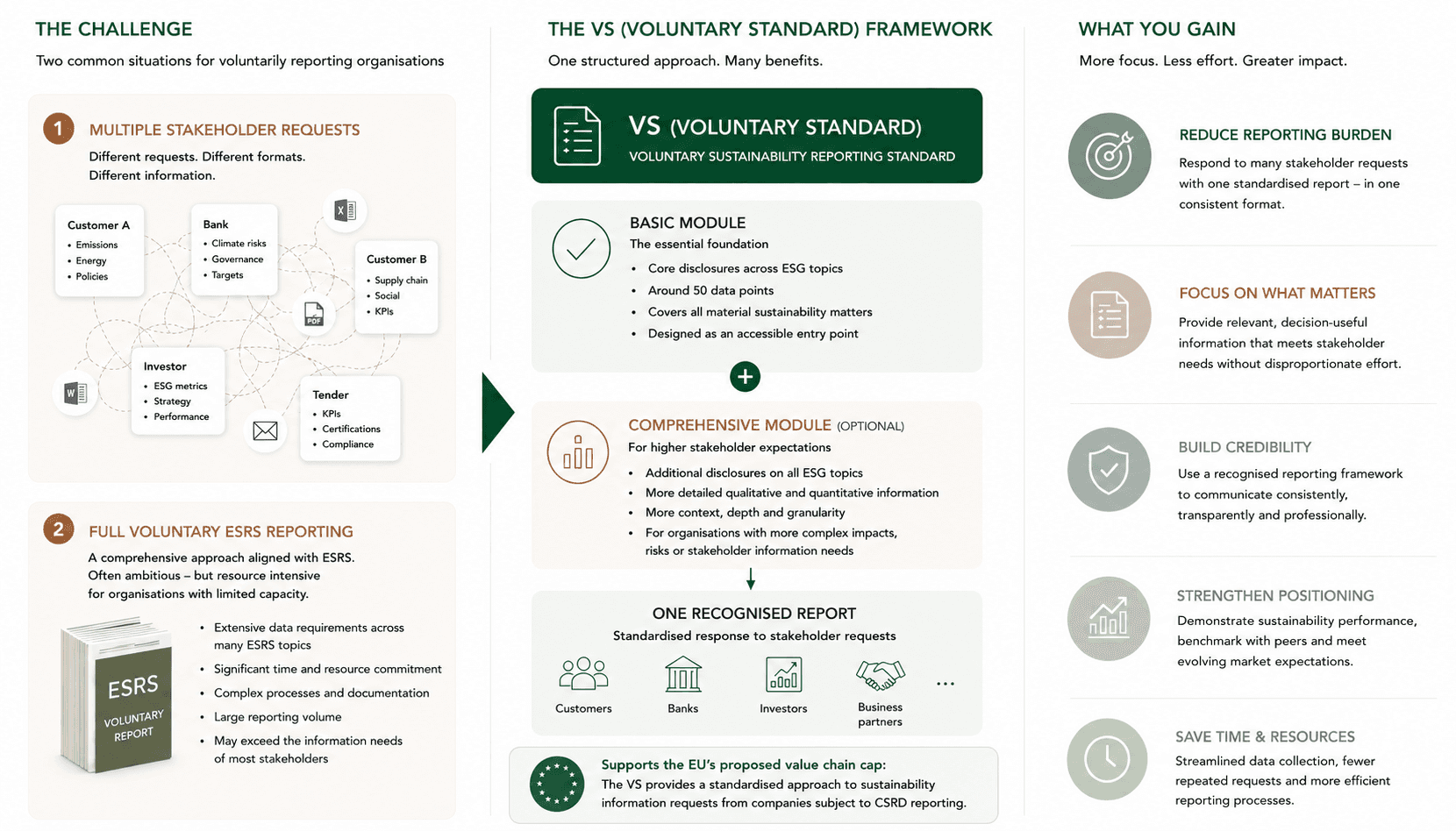
The Voluntary Standard (VS), replacing the former VSME recommendation, provides a structured framework for organisations choosing to report sustainability information voluntarily, whether driven by stakeholder requests, strategic positioning or internal sustainability ambitions.
Rather than responding to multiple bespoke questionnaires, organisations can rely on a recognised reporting framework that improves consistency and reduces duplicated reporting efforts. The standard also forms the basis for the EU's value chain cap, which aims to limit excessive sustainability information requests from companies subject to CSRD reporting.
The Voluntary Standard (VS), replacing the former VSME recommendation, provides a structured framework for organisations choosing to report sustainability information voluntarily, whether driven by stakeholder requests, strategic positioning or internal sustainability ambitions.
Rather than responding to multiple bespoke questionnaires, organisations can rely on a recognised reporting framework that improves consistency and reduces duplicated reporting efforts. The standard also forms the basis for the EU's value chain cap, which aims to limit excessive sustainability information requests from companies subject to CSRD reporting.
WHY VS REPORTING?
WHY VS REPORTING?
Why organisations report voluntarily
Why organisations report voluntarily
Respond once - Use many times
Respond once - Use
many times
Support financing and business relationships
Support financing and business relationships
Build a credible market position
Build a credible market position
Gain better internal transparency
Gain better internal transparency
The VS is designed to provide a standardised basis for recurring sustainability information requests across the value chain. While additional information may still be requested in specific situations, using a recognised framework can improve consistency and reduce duplicated reporting efforts.
The VS is designed to provide a standardised basis for recurring sustainability information requests across the value chain. While additional information may still be requested in specific situations, using a recognised framework can improve consistency and reduce duplicated reporting efforts.
Structured sustainability information can strengthen financing discussions with banks and support customer expectations, procurement processes and business partnerships.
Structured sustainability information can strengthen financing discussions with banks and support customer expectations, procurement processes and business partnerships.
Many organisations choose voluntary sustainability reporting to benchmark against peers, demonstrate sustainability ambitions and communicate consistently using a recognised framework.
Many organisations choose voluntary sustainability reporting to benchmark against peers, demonstrate sustainability ambitions and communicate consistently using a recognised framework.
Collecting structured ESG information helps organisations better understand energy use, emissions, workforce topics and governance arrangements, supporting informed business decisions beyond reporting alone.
Collecting structured ESG information helps organisations better understand energy use, emissions, workforce topics and governance arrangements, supporting informed business decisions beyond reporting alone.
TIMELINE
TIMELINE
From planning to a structured VS report
From planning to a structured VS report
Define reporting
objectives
Define reporting
objectives
Clarify objectives, identify stakeholders and determine the appropriate VS reporting approach.
Clarify objectives, identify stakeholders and determine the appropriate VS reporting approach.
BARNS Step 1
BARNS Step 1
Assess requirements
& address gaps
Assess requirements
& address gaps
Review applicable requirements, assess data availability and address reporting gaps early.
BARNS Steps 2 & 3
BARNS Steps 2 & 3
Design & embed
the reporting framework
Design & embed
the reporting framework
Develop reporting structures, processes, documentation and governance.
Develop reporting structures, processes, documentation and governance.
BARNS Steps 4 - 6
BARNS Steps 4 - 6
Publish your
report
Publish your
report
Prepare, review and finalise the report for publication and future stakeholder use.
Prepare, review and finalise the report for publication and future stakeholder use.
BARNS Step 7
BARNS Step 7
Approximate timelines. Actual project duration depends on data availability, stakeholder responsiveness, organisational capacity and implementation scope.
Approximate timelines. Actual project duration depends on data availability, stakeholder responsiveness, organisational capacity and implementation scope.
THE BARNS APPROACH
THE BARNS APPROACH
The Voluntary Standard project journey
The Voluntary Standard project journey
Every situation is different — but most projects follow a recognisable arc. The depth and focus of each phase depends on the specific standard, organisation and starting point.
Every situation is different — but most projects follow a recognisable arc. The depth and focus of each phase depends on the specific standard, organisation and starting point.
1
Requirements & intial impact assessment
2
Detailed technical assessment & addressing gaps
3
Reporting framework design
4
Implementation & coordination
5
Training & knowledge transfer
6
Dry run & validation
7
First time reporting & audit readiness
Looking closer at the first step

Based on the project summary and agreed reporting approach, you can decide whether to continue internally or move into Step 2 – Detailed technical assessment & addressing gaps – together with BARNS.
Based on the project summary and agreed reporting approach, you can decide whether to continue internally or move into Step 2 – Detailed technical assessment & addressing gaps – together with BARNS.
The auditor's perspective – built in from the start:
Led by a licensed Wirtschaftsprüfer (German Public Auditor / CPA equivalent), BARNS understands not only how new reporting requirements are implemented, but also how they may later be challenged in an assurance context.
The auditor's perspective – built in from the start:
Led by a licensed Wirtschaftsprüfer (German Public Auditor / CPA equivalent), BARNS understands not only how new reporting requirements are implemented, but also how they may later be challenged in an assurance context.
LOOKING FOR ISSB, GRI OR ANOTHER VOLUNTARY REPORTING FRAMEWORK?
LOOKING FOR ISSB, GRI OR ANOTHER VOLUNTARY REPORTING FRAMEWORK?
Not every voluntary reporting project requires the application of the VS
Not every voluntary reporting project requires the application of the VS
While this page focuses on the VS, BARNS also supports organisations evaluating or implementing other voluntary reporting frameworks, including ISSB and GRI. If you're unsure which framework best fits your organisation's objectives and stakeholder expectations, we're happy to discuss the available options and define the right approach together.
While this page focuses on the VS, BARNS also supports organisations evaluating or implementing other voluntary reporting frameworks, including ISSB and GRI. If you're unsure which framework best fits your organisation's objectives and stakeholder expectations, we're happy to discuss the available options and define the right approach together.
IN FOCUS
Further insights on this topic
Further insights on this topic
Further insights on this topic

Voluntary Sustainability Reporting – What Does It Mean in Practice?
Voluntary Sustainability Reporting – What Does It Mean in Practice?
A practical introduction to the new Voluntary Standard (VS), formerly VSME, and how companies can approach voluntary sustainability reporting.

Digital Product Passport (DPP) for Companies: Understanding Before Planning
Digital Product Passport (DPP) for Companies: Understanding Before Planning
The EU Digital Product Passport is becoming mandatory across more industries. Why it's rarely a technical challenge, and why an early, structured look pays off.

How Much Effort Does the Voluntary Standard Involve in Practice – and How Can It Be Implemented Efficiently?
How Much Effort Does the Voluntary Standard Involve in Practice – and How Can It Be Implemented Efficiently?
How much time and resource the Voluntary Standard as a voluntary sustainability report realistically requires, and how implementation can be approached efficiently.

Value Chain Cap – What CSRD Companies Can Still Request From Their Supply Chain
Value Chain Cap – What CSRD Companies Can Still Request From Their Supply Chain
What CSRD-obligated companies need to consider when collecting supply-chain data, and where scope for further requests remains.

Value Chain Cap – What Suppliers Will No Longer Have to Provide
Value Chain Cap – What Suppliers Will No Longer Have to Provide
The Value Chain Cap limits what CSRD-obligated companies may request from smaller suppliers for their own reporting.

Voluntary Assurance Under the Voluntary Standard – When It Might Be Worth It
Voluntary Assurance Under the Voluntary Standard – When It Might Be Worth It
External assurance isn't required under the Voluntary Standard – when voluntary validation might still be worth considering.

Voluntary Standard (formerly VSME) vs. CSRD/ESRS – Where Are the Differences?
Voluntary Standard (formerly VSME) vs. CSRD/ESRS – Where Are the Differences?
Materiality, assurance, scope: an overview of the key differences between the Voluntary Standard and mandatory ESRS reporting.
From VSME to Voluntary Standard: What Has Changed
From VSME to Voluntary Standard: What Has Changed
From non-binding guidance to a delegated regulation: what appears to have changed as the VSME evolved into the Voluntary Standard.

What is the Voluntary Standard (formerly VSME)? A Quick Overview
What is the Voluntary Standard (formerly VSME)? A Quick Overview
The Voluntary Standard succeeds the VSME, giving companies outside CSRD scope a structured framework for voluntary sustainability reporting.

Voluntary sustainability reporting: What's the point, and when does it make sense?
Voluntary sustainability reporting: What's the point, and when does it make sense?
Voluntary Standard: when does voluntary sustainability reporting make sense for companies outside CSRD scope? A practical starting point.
Let's define the right reporting approach.
Let's define the right reporting approach.
Whether you're preparing your first VS report or looking to establish a different structured voluntary reporting framework, the first step is understanding your objectives, stakeholder expectations and existing ESG information. Together, we define a practical way forward.
Whether you're preparing your first VS report or looking to establish a different structured voluntary reporting framework, the first step is understanding your objectives, stakeholder expectations and existing ESG information.
Together, we define a practical way forward.

Advisory for reporting, accounting and transformation.
© 2026 BARNS GmbH Wirtschaftsprüfungsgesellschaft. All rights reserved.
Advisory for reporting, accounting and transformation.
© 2026 BARNS GmbH Wirtschaftsprüfungsgesellschaft. All rights reserved.
Advisory for reporting, accounting and transformation.
© 2026 BARNS GmbH Wirtschaftsprüfungsgesellschaft. All rights reserved.
Advisory for reporting, accounting and transformation.
© 2026 BARNS GmbH Wirtschaftsprüfungsgesellschaft. All rights reserved.